

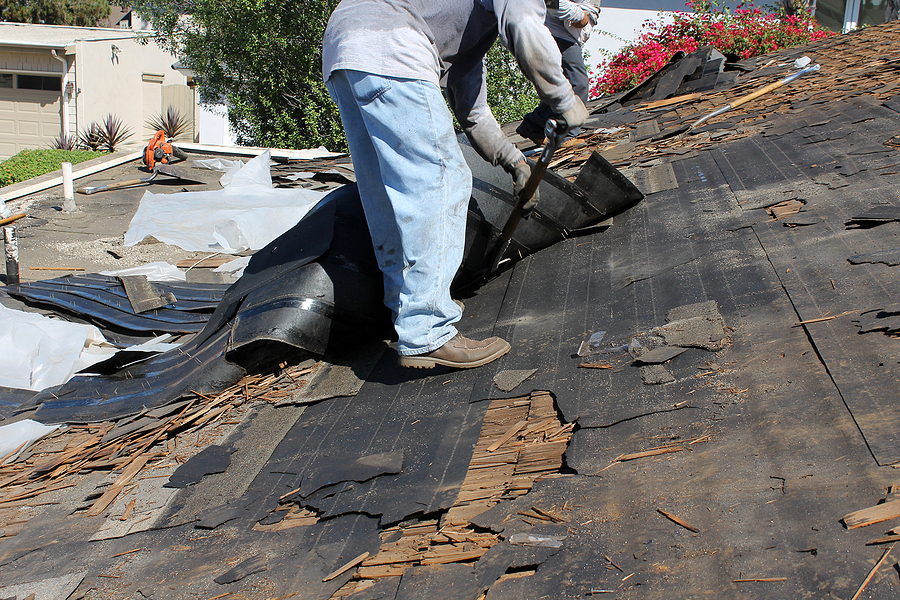
Roof-related damage accounts for 70 to 90 percent of all catastrophic homeowners insurance losses in a typical year, according to the Insurance Institute for Business & Home Safety (IBHS). When a roof fails, it often takes ceilings, insulation, and drywall with it, sometimes even whole rooms. The cost of catching a problem early versus catching it late often differs by tens of thousands of dollars.
The frustrating part is that roofs almost always announce their decline before they give up. But most homeowners don’t know what they’re looking at. We’ve spent more than 18 years inspecting roofs across York County, and have a handful of warning signs every homeowner should memorize.
7 Signs Your Roof Is Failing
Curling, Cracking, or Buckling Shingles
Healthy asphalt shingles lie flat and uniform across the roof. When the edges start curling upward, the corners cup inward, or the surface looks wavy, it means the asphalt has dried out and lost its flexibility.
This is the most visible sign of an aging roof, and Maine’s climate accelerates it dramatically. Every freeze-thaw cycle expands and contracts the shingles, and after enough cycles, the asphalt can’t snap back into place.
Once shingles curl, they create gaps that wind can grab. If you see widespread curling, the roof is past the point of repair.
Granules in the Gutters
Those small, sand-like granules covering asphalt shingles aren’t decoration. They’re the UV shield that protects the asphalt beneath from breaking down in the sun. When you start finding piles of them in your gutters or at the bottom of downspouts, the roof is shedding its protective layer.
A brand-new roof sheds a few loose granules in the first year, but an aging roof sheds them constantly. If you see bare, shiny black patches where the granules have worn off, the asphalt underneath is now exposed to direct UV. And once the granule layer is gone, the shingles typically have only a few years left.
Missing or Damaged Shingles
A single missing shingle from a recent storm is a repair. Multiple missing shingles, shingles scattered across different sections, or shingles you find in the yard after every windstorm point to a system-wide problem.
Asphalt shingles are designed to seal to each other with a heat-activated adhesive strip. Once that seal breaks down with age, every shingle becomes a potential takeoff point in high wind.
If you can spot bare patches from the ground, water is already finding the underlayment, and the underlayment alone is not designed to keep your home dry long-term.
Water Stains on Ceilings or in the Attic
Brown rings on the ceiling or dark streaks on the underside of the roof deck in the attic indicate that water has gotten past the roof system. By the time you see a stain on a ceiling, the leak has already soaked through the underlayment, decking, and insulation.
Check the attic with a flashlight after heavy rain and after winter thaws. Then look for darkened wood, rusty nail heads, and any wet or compressed insulation.
Sagging Rooflines
Step across the street and look at your roofline against the sky. It should be straight from ridge to eave, with no dips or waves. Any sag, curve, or visible deflection is a serious warning that demands immediate attention.
Sagging usually means the roof deck has absorbed water and started to rot, or that the rafters and trusses underneath have been stressed beyond their design load. A sagging deck can fail structurally. So, this is the one sign on the list that moves a roof from “watch it” to “call Precision Roofing now.”
Damaged or Lifting Flashing
Flashing is the metal that seals the roof at chimneys, valleys, vents, plumbing stacks, skylights, and where the roof meets walls or dormers. It’s also where most roof leaks start.
If you can see flashing that’s lifted, rusted through, cracked, or pulling away from a chimney, water has a direct path into the home. Proper metal flashing, correctly integrated with the shingles and underlayment, is the only durable solution.
The Roof Is Old
Age alone is a sign, even when nothing visible is wrong yet. A standard three-tab asphalt roof in Maine typically gives 15 to 20 years; architectural shingles, 25 to 30; metal roofs, 40 to 50 or more.
A roof that looks fine from the ground at year 24 can fail catastrophically at year 26. The math here favors getting ahead of it. Replacing a roof a few years before it fails costs the price of a roof. Replacing it after it fails costs as much as a roof, plus damaged decking, ruined insulation, interior repairs, and the inconvenience of dealing with active leaks during the work.
What to Do If You’re Seeing These Signs
Contact Precision Roofing to request a free estimate online. We’ll come out, take a look, and tell you whether you’re looking at a quick fix, a few more good years, or a full replacement.